
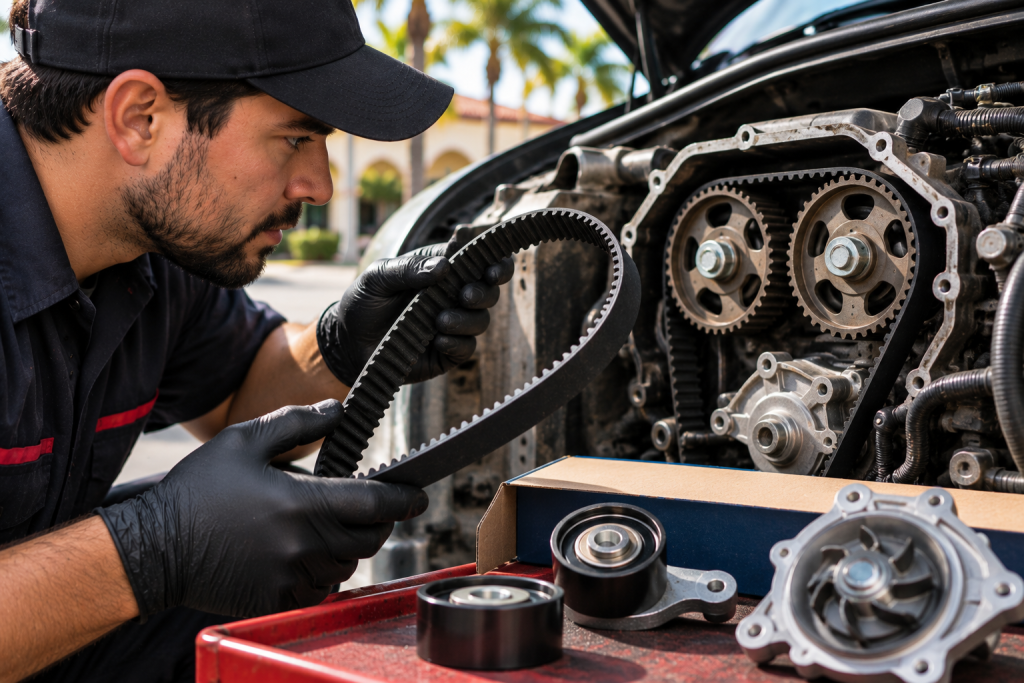
Few parts under the hood are as important and as easy to forget as the timing belt. You cannot see it without removing covers, it rarely makes noise until the end, and a car can feel perfectly normal right up to the moment it fails. When it does fail, the result can be a car that stops running on the spot, and on some engines it can mean serious internal damage. This guide explains what a timing belt does, why it needs to be replaced on a schedule, how to know when yours is due, what happens if it snaps and how to handle the job. If you have been searching for timing belt replacement in Hialeah, here is what every driver should understand.
What the Timing Belt Does
Inside your engine, the crankshaft and the camshaft have to turn in careful coordination. The crankshaft moves the pistons up and down, while the camshaft opens and closes the valves that let air and fuel in and exhaust out. The timing belt is the toothed rubber belt that links them and keeps them in step. If the two drift out of sync even slightly, the engine runs poorly, and if the belt breaks, the link is gone entirely.
In many engines the timing belt also drives other parts, which may include the water pump or an oil pump, depending on the design. That is one reason a timing belt job is often discussed alongside other components.
Timing Belt or Timing Chain?
Not every car has a timing belt. Some engines use a metal timing chain instead, which is built to last and generally does not follow the same replacement schedule. Others use a belt that needs to be replaced at a set point. The way to find out is simple:
- Check your owner’s manual, which lists the engine’s timing component and the service schedule.
- Look up the maintenance schedule for your exact year, make and engine.
- Ask a technician, who can tell you what your engine uses.
Do not assume. Cars that look nearly identical can use different systems depending on the engine.
When Should a Timing Belt Be Replaced?
This is the question everyone asks, and the honest answer is that it depends on the vehicle. Manufacturers set replacement intervals based on distance driven, on time passed, or on both. Many specify whichever comes first, because a belt can age and wear even if the car is not driven much. Your owner’s manual or maintenance schedule gives the interval for your car, and that is the number to follow.
A few things to keep in mind:
- Time matters as well as mileage. Rubber ages with heat and years, even on a car with low use.
- Hot climates are hard on rubber. South Florida heat and humidity can add stress to belts, hoses and seals, so it is wise not to push a due date further out.
- A used car may have an unknown history. If you bought a car and have no record that the belt was changed, ask a technician to review it. Do not assume it was done.
- Keep records. Write down the date and the odometer reading whenever the belt is replaced, so you know when the next one is due.
Signs the Timing Belt May Be Wearing Out
The tricky thing about a timing belt is that it often gives little or no warning. Still, there are some symptoms that can point to a problem with the belt or the parts around it:
- Ticking or slapping noise from the engine. A worn belt or tensioner can make unusual sounds.
- Trouble starting or an engine that cranks but will not fire. The timing may have slipped.
- Rough idle or misfires. If the timing is off, the engine can run unevenly.
- Loss of power. The engine may feel weak or hesitate.
- Oil leaking near the front of the engine. Oil can soften and damage a belt.
- Check engine light. Timing problems can trigger a code, although many other issues can too.
- Visible cracks, fraying or missing teeth. This is only visible when covers are removed, so it is something a technician checks.
Some of these signs can also come from other problems, so do not try to diagnose it on your own. The safest way to know is to follow the schedule and have a technician inspect the system.
What Happens If a Timing Belt Snaps?
When the belt breaks, the camshaft and crankshaft are no longer connected. The engine stops running immediately, which can be dangerous if it happens while you are driving, since you may lose power assist for steering and braking assistance as the engine shuts off. If this happens, keep calm, steer to a safe spot and brake firmly, then turn on your hazard lights.
What happens next depends on the engine design:
- Interference engines. In these designs, the pistons and the valves share space at different moments. If the belt snaps, the valves can be hit by the pistons, which can bend or break valves and cause other internal damage. That can turn a maintenance job into a major repair.
- Non interference engines. In these designs, the pistons and valves are designed not to collide, so a broken belt may leave the car stranded but with much less damage.
You will not always know which type you have, which is one more reason to treat the timing belt as something to replace on schedule instead of waiting for it to fail. If the belt has broken, do not keep trying to start the engine, because that can cause more damage. Have the car towed and inspected.
What a Timing Belt Replacement Usually Includes
Replacing the belt is a job that takes skill and care, because the timing has to be set exactly right when it is reassembled. In addition to the belt itself, a technician will often look at related parts that wear at similar rates, such as:
- The tensioner and idler pulleys, which keep the belt at the right tension and guide its path.
- The water pump, on engines where the belt drives it. Because much of the labor overlaps, it is often discussed at the same time. Our guide to the signs of a failing water pump explains what to watch for.
- Seals and gaskets, if there are leaks in the area.
- Drive belts and hoses, which may be inspected at the same time.
What is included depends on the engine, so ask for a clear explanation of what is recommended and why, and follow your manufacturer’s guidance. A good technician will be open about which parts are needed now and which can wait.
Why Hialeah Driving Can Be Tough on Engines
Heat, humidity and a lot of idling at lights all add to wear on a car. Drivers who spend much of their day in heavy traffic put extra hours on the engine without adding many miles. That is one more reason to pay attention to the time based part of the maintenance schedule. Our Hialeah driver’s guide to stop and go traffic and your transmission covers another part of the car that feels the strain of daily traffic.
Can a Mobile Mechanic Replace a Timing Belt?
It depends on the car. A mobile mechanic can come to your home or workplace in Hialeah to inspect the belt area, check for leaks and noises, review your maintenance records and explain what your engine needs. Some timing belt jobs can be done on site if the engine design and the working conditions allow it. Others involve a lot of disassembly, specialized tools or a lift, and may be better handled in a shop. A trustworthy technician will tell you which is the case for your car before starting, and will not cut corners on something this important.
Tips to Avoid a Timing Belt Surprise
- Look up your car’s schedule in the owner’s manual and find out whether it has a belt or a chain.
- Do not skip the time limit, since belts age even when the car is not driven much.
- Keep service records, including the date and odometer reading for any belt work.
- Fix oil and coolant leaks promptly, since fluids can damage the belt and related parts.
- Do not ignore new noises from the front of the engine.
- Ask questions before buying a used car, including whether the belt has been replaced.
- Stop driving and get help if the engine suddenly stalls or will not start, instead of repeatedly cranking it.
Quick Timing Belt Summary
- The timing belt keeps the engine’s moving parts in step.
- Replace it on the schedule in your owner’s manual, by distance or time.
- Some engines use a chain instead, so check yours.
- A snapped belt can stop the engine and, on some engines, cause serious damage.
- Related parts such as the tensioner and water pump are often looked at together.
- Some jobs can be done at your home, and others may need a shop.
Replacing a timing belt on time is far easier than recovering from a failure on the road. If you would like help figuring out what your car needs, visit the Mobile Mechanic Pros of Hialeah homepage to learn more, or contact us to schedule a visit.